Cuisine is an important content of culture, both material culture and spiritual culture. When cuisine is cultural, reaching the cultural category, it represents a core character and virtue of a nation.
Ancient Vietnamese people often ate frugally – mainly due to poverty, also due to agricultural economic characteristics and geographical location and climate in Southeast Asia. From homegrown plants, from crabs and snails in the fields and ponds, they are also prepared simply to become dishes rich in hometown flavors: You go, you miss your homeland, Remember water spinach soup, remember pickled eggplants with soy sauce (Ancient folk song). Or: “Nhut Thanh Chuong, Nam Dan soy sauce”, and: “Dua La, Lang basil, Bang spring rolls, Ban soy sauce/Van Van fish sauce, Dam Set perch”, etc.
During meals, Vietnamese people eat rice as the main meal, food as a side dish: "Three bowls of rice, three thang medicine". Rice cooked with plain rice. Our grandparents taught us: "… When you are full of plain rice, you will stop doing everything." Indeed, eating a lot of delicious things, including delicious delicacies, without having any rice in your stomach, you don't feel satisfied at all.
Vietnam's wet rice agriculture has many famous and delicious rice varieties: Du rice, di Huong, eight pineapple, eight oval… today we can also breed many new rice varieties that are both delicious and high-yielding. Sticky rice is often used to cook sticky rice (sticky rice), make oats, and worship heaven, earth, and ancestors on full moon days and folk festivals; or make all kinds of cakes, such as banh troi, banh khuc, banh how, banh xe… which are incredibly delicious.
During a meal, there must be a dipping sauce to be delicious and rich. Dipping sauce made from shrimp, fish, and fiddler crab is called fish sauce. Van Van, Cat Hai, and Phu Quoc fish sauces are famous and delicious. Dipping sauce made from soybeans is called soy sauce, such as Ban soy sauce (Ban Yen Nhan), Nam Dan soy sauce; Made with peanuts, Northerners call it soy sauce (in Chinese), Southerners call it soy sauce. Fish sauce is skillfully prepared, often with added spices: Lemon, chili, vinegar, garlic, sometimes with a little sugar, creating a sweet and sour taste depending on taste, or adding a few slices of ginger to warm the stomach when eating cold dishes. There is also fish sauce marinated with grilled Ca Cuong, which has a very special flavor, only available in the past, to gourmets.
Spices in the meal also include vegetables and fruits: Coriander, Chinese coriander, marjoram, mole basil, dog basil, perilla, green bananas, cucumbers… Many spices are also herbal medicines that can cure many diseases, seemingly normal but very precious.
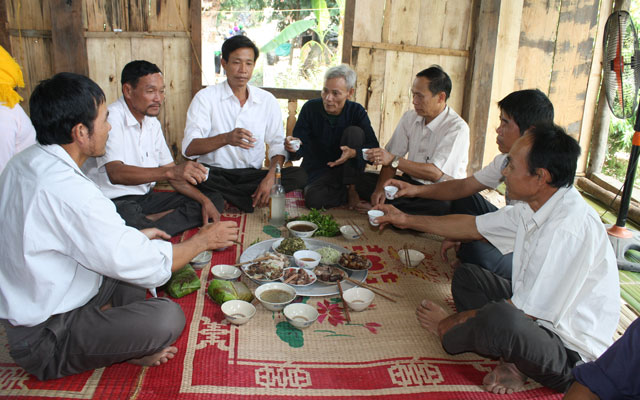
Men at meals, especially during worship ceremonies, often have a horizontal cup of wine (now also called ethnic wine, or national wine, to distinguish it from Western wine). Horizontal wine made with ordinary rice, with cassava (cassava), but the most precious wine made with sticky rice, the best is black sticky rice, the taste is very delicious.
Many modern parties, in addition to beer and Western wine of all kinds, but many sophisticated people still like alcohol. Many famous wine making regions, such as Van Village Wine, San Lung wine in Sa Pa, Lao Cai, and sole wine in the South.
Our ancestors did not value food and did not seek great flavors, but they highly valued the way of eating and appreciated the gratitude in culinary communication.
The elders often remind their children and grandchildren: "Eat, watch the pot, sit and watch the direction", "Eating must chew, speaking must think", "Learn to eat, learn to speak, learn to wrap, learn to open", "One bite when hungry, equal to one packet when full", "Fight to share rice, greet each other to eat rice"…
People who are close friends often miss their friends so much that they forget to eat or drink. Tam Nguyen Yen Do Nguyen Khuyen (1835-1909) – poet of Vietnamese landscape villages, once "Crying Duong Khue" (1839-1902): Good wine without good friends Don't buy it, don't buy it if you don't have money!
The culinary culture of our ancestors is imbued with national morality and Vietnamese identity. People must know how to preserve and be careful when eating and drinking: "Eat according to the place, sleep according to the place". The elders often criticized the "price of clothes and rice bags" group, the "ordinary people", "hate people, love things" – hate people, but whenever they see people eating, they flatter and flatter to get a chance to eat. If you are greedy for food and drink, if you don't know how to be shameless, then every bite of food will be a dishonorable piece of food: "Too much will lead to ruin"!
Vietnamese people value honor, are very alert and are also very practical in eating. Just think about the story of "Man Man", and you will see that the philosophy of the culinary culture of the ancients is very high and very deep.
Bom only had a mo fan, but the rich man wanted to exchange it for many valuable assets: three cows and nine buffaloes, a deep pond of silver carp, three ironwood rafts, and a tortoiseshell bird. I don't understand why the rich man is so greedy for that mo fan, or is he just mocking and deceiving Bom to show that he is too rich and considers the wealth he owns to be nothing! But, the Mane hasn't changed. Only when the rich man exchanged it for a handful of sticky rice did Bom laugh.
It turns out that Vietnamese workers, no matter how hungry or thirsty they are, still value honor ("If paper is torn, you must keep the margin", "Hunger to clean, torn to smell good"); not easily deceived and focus on the practicality of eating.
When you are hungry and thirsty, you need food to live, and a handful of sticky rice is commensurate with the value of your mo fan. The handful of sticky rice is present, but the three ironwood rafts, the deep carp pond… are nowhere to be seen. Therefore, exchanging the mo fan for a handful of sticky rice is the most appropriate and practical for Bom!
If you work, you will eat. Eating and drinking must come from one's own labor, then one can eat well and sleep peacefully; Do not use meaningless things: "Hands work, jaw chews; Hands hold, mouth slack"; "If you eat rice with fish sauce, you'll snore; If you eat rice with beef, you'll snore."
The poet Nguyen Trai (1380-1442) awakened people: The rice of the inhumane, if eaten, is not worth the meaningless clothes of the people, wearing it, is not better. The philosophy of Vietnamese culinary culture is also expressed in the wise concept: "Eat to live, not live to eat"; At the same time, know how to save and appreciate the results of other people's labor.
The elders often remind their children and grandchildren: Grains of rice are "real gems", or: "If you have a good harvest, don't depend on corn and potatoes/When the harvest fails, marry someone to be your friend"; and: "Hey, bring a bowl full of rice/It's fragrant with just one grain, bitter and bitter." Therefore, eating and drinking should not be wasted, not letting a single grain of rice fall out.
President Ho Chi Minh – the great leader of our Party and people, Hero of national liberation, World cultural celebrity – in terms of daily life, he is the crystallization and representative of the philosophy of Vietnamese culinary culture. Prime Minister Pham Van Dong told about Uncle Ho's frugal daily meals: "Meals only had a few very simple dishes. When eating, Uncle Ho did not let a single grain of rice fall out. After eating, the bowl was always clean and the remaining food was neatly arranged. In those small things, we see even more how much Uncle Ho values the results of human production and how much he respects those who serve" (Pham Van Dong – "Our Fatherland, our people, our cause." I and the artist", Literature Publishing House, Hanoi, 1973, p.278).
Today's culinary culture generally still retains the good old ways, especially in simple rural areas. Now, due to people's improved lives, cultural and social development and widespread international exchanges, our people's meals have many new things, or are processed more improved than before, richer in nutrients, beautifully presented, and the way of eating is also many times more lively than before. However, unfortunately there are many people, many wanderers who are greedy for food and drink to the point of losing their personality.
Many people value food more than friendship, they eat everywhere, even sitting next to stinking gutters; You eat everything, including unhygienic food, laced with chemicals and dyed with toxic dyes.
Many people, whenever they have any work, try to figure out how to eat and drink first, then make the excuse: "It's really a miracle"! Many people in positions of authority have embezzled a lot of money and assets of the State, or fraudulent trading guilds, black markets with a lot of money, spending lavishly and extravagantly with lots of delicious and strange things, to the point that even if the kings of the past were resurrected, they would have to "worship" (!).
While the country and its people are still poor and constantly suffering from natural disasters, many localities, agencies and units waste State money to eat and drink. Many drinking and partying sessions with… "temple money"; or village festivals, clan associations, hometown associations, and sect associations contribute money and then eat and drink lavishly, "alcohol in, profits out", accompanied by gambling parties, shrimp nests, and coin tossing, causing ridiculous things, discord, and sometimes even murder. These are very countercultural cuisines. Therefore, preserving the culinary cultural traditions and culinary cultural philosophies of the nation is one of the big and pressing issues of life today. It is the protection and promotion of the beauty and civilization of the Vietnamese people, the Vietnamese identity.
Dao Ngoc De