Van Village, the literal name is Yen Vien, is an ancient village on the North bank of Cau River, converging many layers of unique heritage of the region Kinh Bac: traditional wine making, Water-ball Wrestling festival, system of communal houses, temples, pagodas, Tam Quan market, the custom of marriage and a strong community life. Having gone through many changes, Van Village today is still a “living heritage”, where traditions are preserved and continued in the rhythm of modern life.

Van Village – heritage domain living next to the Cau River
Located on the northern bank of Cau River, Van Village is an ancient countryside with strong cultural imprints Kinh Bac. The village’s literal name isYen Vien, now belongs to residential group Yen Vien, ward Van Ha, province Bac Ninh. For many generations, the river has not only deposited alluvium, nourished fields and residents’ lives, but also opened routes for cultural exchange, products and people between the two banks. It is in that space that a strong village community has formed, creating unique values of history, beliefs, occupations and customs.
When mentioning Van Village, people often immediately remember itVan Village Wineandfestival Water-ball Wrestling. However, the village’s depth lies not only in those two famous heritage sites. It is also a cultural whole including temples, pagodas, water wharves, festival grounds, traditional crafts, rural markets, marriage customs, family lifestyle and memories of many generations. Each element has its own life and is interconnected, forming the identity of a long-standing village along the Cau River line.
An ancient village named Yen Vien
The name Yen Vien evokes the image of a peaceful land, where people gather and build a life in close association with fields and rivers. Through the documents still preserved in relics, epitaphs, legends, genealogies and folk memories, it can be seen that the history of Van Village has been accumulated over many centuries. The country’s upheavals, changes in administrative boundaries and economic transitions have made the village’s appearance constantly change, but the village name, village customs and community sentiments are still passed down.
A milestone that people often mention with pride is the 22nd year of Tu Duc, that is, the year1869, the village Yen Vien is bestowed with four words“Fine customs”– recognizing good customs that are worth praising and passing on. That title not only talks about a historical period, but also reflects how the community sees itself: valuing love, respecting ancestors, preserving rules and promoting harmony in the village.
The history of Van Village should therefore not be told only in chronological terms. That history is also present in the way places are called, in the stories of the elderly, in holidays, in the relationships between clans, in the altar of each family and in the return of children far from home.
Cultural space is associated with rivers and beliefs
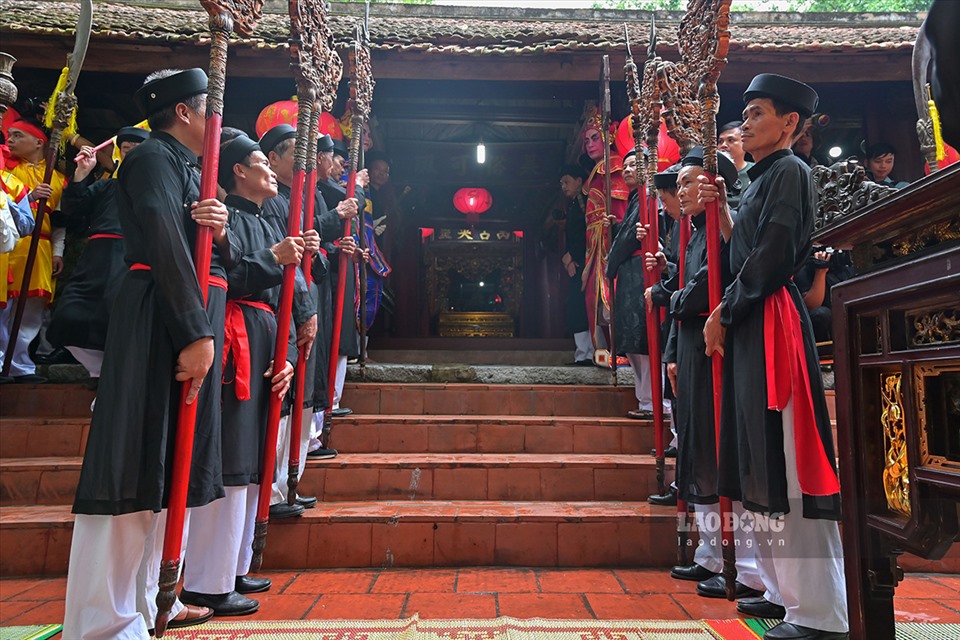
Van Village’s traditional spaces are organized around places of special significance to the community. In there,Main Temple, also known as Ha Temple or Van Temple, is an important religious center and the place where many rituals of the Water-ball Wrestling festival take place. The relic is associated with the belief of worshiping Saint Tam Giang Truong Hong – Truong Hat, figures revered by the people as gods who are credited with preserving the country and protecting riverside residents. Currently, this place is identified as a national monument and continues to play a central role in the cultural life of the community.
Along with the temple is a system of pagodas, worship spaces, ancient trees, festival grounds, water wharves, village roads and places associated with winemaking. Those places do not exist separately but are closely related to daily life. Temples are places to practice religion; The pagoda is a place to convey spiritual life; The courtyard is where the community meets; The river wharf used to be a transportation and goods exchange hub; The houses in the village are where occupations, customs and family memories are preserved.
Cau River is an inseparable part of that cultural space. The river is both a natural boundary and a road connecting Van Village with neighboring villages. Water rhythms, mudflats, flood seasons and ancient ferry trips have influenced production methods, landscapes and the way people feel about their homeland. Therefore, preserving Van Village is not only about preserving a few architectural works, but also preserving the relationship between monuments, riverside landscapes and residents’ lives.
Van Village Wine – the crystallization of knowledge and reputation of the craft village

Van Village Wine is a product that has made this land famous for many generations. Wine making at Yen Vien has a history of hundreds of years and was once an important source of livelihood for many families. Over time, the name Van wine or Van Village Wine is no longer just used to refer to a type of drink, but has become a sign of identification of the homeland.
Behind each batch of wine is a whole system of folk knowledge: selecting and processing ingredients, preparing yeast, controlling temperature, incubation time, distillation techniques, preservation and quality assessment. Many stages depend on the sensory experience of the craftsman – from seeing, smelling, tasting to listening to changes during fermentation and distillation. These experiences are accumulated through long-term work, often passed from previous generations to the next within the family and professional community.
The value of Van Village Wine therefore lies not only in the final product. More important is the professional knowledge, ethics of the producer, how to choose raw materials, respect for quality and community reputation. In traditional life, wine is also present in ceremonies, weddings, death anniversaries, receptions and meetings. A cup of wine is a greeting, a connection, but at the same time requires a civilized, responsible and legal attitude.
Today, the wine industry faces demands for innovation in quality standards, food safety, packaging, traceability and branding. The problem is to develop products in a modern direction without losing the identity and core knowledge of the profession. Preserving Van Village Wine therefore must start from respecting the cultural subject – the families, artisans and workers who directly maintain the profession.
Water-ball Wrestling – strength, faith and community spirit
If Van Village Wine is the crystallization of labor and professional knowledge thenWater-ball Wrestlingis a prominent symbol of festival life. The game was held on a mud field in front of area Main Temple, where the shuttlecocks competed for a large ball in flooded and slippery field conditions. Participants must have good health, dexterity, coordination and high discipline.
Water-ball Wrestling is more than just a contest of strength. The preparation rituals, choosing the shuttlecock, presenting it to the Saint, bringing the shuttlecock to the field, drumming, costumes and game rules all have cultural and religious significance. The images of the globe, the water court and the bridge competition are often interpreted by the community in connection with agricultural beliefs, the wish for good weather, good crops and a peaceful life.
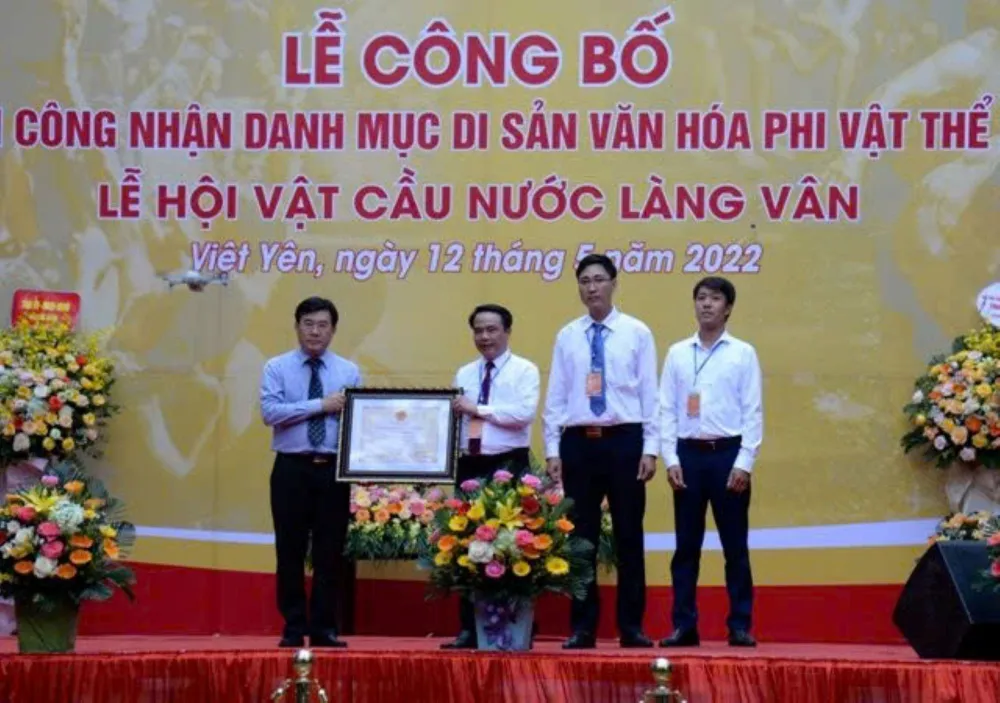
January 12, 2022,Van Village Water-ball Wrestling Festivalwas included in the National Intangible Cultural Heritage List by the Ministry of Culture, Sports and Tourism. This recognition affirms the typical value of the festival, while also placing greater responsibility on the community and government in protecting sacred spaces, maintaining rituals, transmitting knowledge and organizing safe and authentic festivals.
What makes the festival lively is not only the exciting football matches, but also the participation of the whole village. Ritual performers, grounds preparers, temple keepers, military shuttlecocks, families who serve the festival, elders who pass on village customs, and young people who support the organization – all together create a truly communal cultural activity.
Beautiful customs and love of marriage
One of the unique features of Van Village is its vulgarityconnection between Yen Vien and Dong Gao, also known as Ngu Xa, is on the other side of Cau River. Over many generations, the people of the two villages consider each other as brothers, attend festivals, support each other when they have common tasks and preserve the friendly rituals passed down from their ancestors. Love not only exists in rituals at communal houses and temples but also goes into daily life, expressed through help when one party faces difficulties or has a big job.
The custom of marrying shows that traditional village culture is not closed. Besides the sense of protecting their honor and identity, Van Village residents also build lasting relationships with the neighboring community. In the current context, that spirit still has a profound meaning: respecting differences, keeping trust, living responsibly and knowing how to support each other.
Tam Quan Market – a market of memories and lifestyle
Van Village also has a special market:Tam Quan market, usually meets on December 25. According to epitaph documents, the market in this area has appeared since the 17th century. Later, when the three-entrance gate of the village pagoda was built, the year-end market was held in the temple yard area and gradually became a unique feature of the locality.
The market mainly sells agricultural tools, household utensils and items for Tet such as dong leaves, bamboo leaves, betel leaves, flowers and countryside products. Due to meeting in a space attached to the temple, people keep restrictions on killing and unclean items. Buyers and sellers communicate gently, not placing too much emphasis on profits. Therefore, going to Tam Quan market is not only about shopping but also an opportunity to meet, ask questions and feel the atmosphere of Tet coming.
In modern life, many items can be easily bought anywhere, but the market is still valuable because it preserves the memory of a village economy, public behavior and the need for community meetings at the time of transition from the old year to the new year.
Community life in a rhythm of change
Van Village today is no longer an isolated village. Transportation, housing, production methods, education, information and social relationships have all changed. Many people work outside the locality; The younger generation has quick access to technology and new ways of living; Production activities must also adapt to market requirements.
However, traditional values are still present in life. People continue to take care of the relics, maintain festivals, worship ancestors, maintain kinship relationships and look forward to their homeland. Children far from home, even though they live in many regions or abroad, still contribute their efforts, materials and experience to the common activities of the village.
The biggest challenge today is how to keep tradition from turning into a form of performance that is far away from the community. Heritage is only truly alive when people still understand, practice and realize its value in life. Therefore, conservation needs to be associated with educating the young generation, building sustainable livelihoods, protecting the environment, beautifying the landscape, developing responsible tourism and applying technology to preserve documents.
Preserving memories, paving the way for the future
The history of Van Village is not a closed story. Every old photo, every genealogy, ordination, epitaph, winemaking utensils, oral history or an elderly person’s memory can add a piece to the village’s appearance. Digitizing and systematizing these documents will help future generations access their homeland’s history in a more complete and reliable way.
Along with preserving physical relics, attention should be paid to recording vocational knowledge, festival rituals, place names, family customs, family stories and changes in contemporary life. In that process, the people of Van Village must be the subject: be provided with documents, participate in verification, decide the scope of publication and benefit from heritage promotion activities.
From the Cau River line, the houses, the smell of wine, the sound of festival drums, the muddy bridge yard to the year-end market and the love between the married communities, Van Village has created an identity that is not easy to mix. It is an identity formed from work, respect for ancestors, sense of community and the ability to adapt through many changes.
Van Village today is both a place to return to and a space to explore and learn. Preserving Van Village not only aims to save traces of the past, but also to give the future a community that appreciates its roots, a humane landscape and a heritage that continues to live in people’s lives.
Van Village
Articles about Van Village
New stories and documents from Van Village.

Yen Vien – Dong Gao: Hundreds of years of meaning, deep love
(BGĐT)- Van Village, also known as Yen Vien, belongs to Van Ha commune, Viet Yen district, Bac Giang province. In the 22nd year of Tu Duc's reign (1869),…
Read more →
Van Village today – preserving heritage in the new rhythm of life
Van Village today does not stand aside from the process of urbanization, production transformation and administrative arrangement. The challenge is how to develop infrastructure, livelihoods and tourism without…
Read more →
“My Tuc Kha Phong” and the custom of marrying Yen Vien – Dong Gao
The four words "Fine customs" and the relationship of more than three centuries with Dong Gao village are two typical manifestations of Van Village's behavioral culture: respecting meaning,…
Read more →
Heritage space Van Village – communal houses, temples, pagodas and riverside memories
Van Village heritage is not a discrete collection of ancient buildings. It is a whole including temples, communal houses, pagodas, documents, festival grounds, river wharves, village alleys and…
Read more →
Timeline Van Village – from Yen Vien to today’s heritage community
Van Village history is preserved in legends, architecture, epitaphs, ordinations, customs, traditional occupations and people's memories. The timeline below helps readers identify important milestones and distinguish between documented…
Read more →
Van Village – Heritage lives alongside the Cau River line
Located on the northern bank of Cau River, Van Village - ancient name Yen Vien - is a unique cultural space of the Kinh Bac region. Here, river…
Read more →
Van Village Temple – national architectural and artistic monument
1. GENERAL INFORMATION Name: Van Village Temple Other name: Main Temple of Yen Vien village Specific address: Yen Vien residential quarter, Van Ha Ward, Bac Ninh Province Geographic location and landscape…
Read more →
“Van Village culture”
There is a state of mind that a part of humanity tries to avoid, and that is sadness. People know it exists but avoid talking about it because…
Read more →