The history of Van Village through fairy tales that my grandmother often told her grandchildren said, "Van Village is located on the Cau River, full of water all year round, and has a traditional profession of making wine. The profession has existed for a long, long time. At first it was just small hamlets growing along the riverbank, then it became a village and a town. Making wine has become an art with secrets that the village's ancestors once told their children to always keep for Van Village alone. When the French colonialists came to the village, they gathered all the villagers to a factory right at the beginning of the village and forced everyone to make wine.
When the wine was finished, ships along the Cau River docked and transported it to France. Van Village's yellow-flower glutinous rice wine follows it to all directions…" Van Village's wine has long been famous for its deliciousness thanks to the aroma of yellow-flower glutinous rice – a particularly delicious sticky rice mixed with Van Village's esoteric fermentation starter. After 72 hours of maceration, the sticky wine is like the most quintessential gift of heaven and earth to humans. But that is the story of the past. Nowadays, Van Village still makes wine, but has switched to using another ingredient, cassava.
Dried cassava is imported from Hoa Binh, Yen Bai, Thai Nguyen, Cao Bang, Tuyen Quang, Lang Son… cut into lengthwise pieces, about 5 – 7 cm long. After being selected, dried cassava is placed in barrels or pots and soaked for a few hours to loosen the skin.
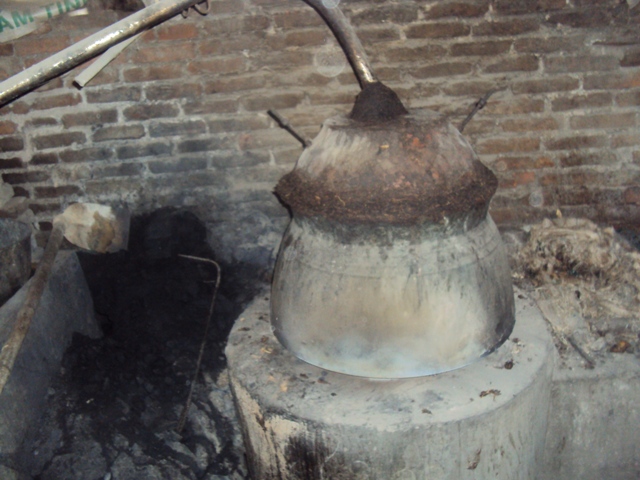
Then wash, steam until cooked and mix with yeast to ferment. Enough for one day and night to soak and ferment in ceramic jars. When it smells good, put it in the oven to make wine. The process of making cassava wine is not much different from rice wine, the only thing is the type of yeast. Mr. Nguyen Duc Minh, one of the owners of a large cassava winery in Van Village, said: "In the past, we all brewed rice wine. If we had big jobs and needed good wine, we would cook Ca Hoa Vang sticky rice, but over the past ten years, our family has completely switched to making cassava wine. Cassava wine is cheap, delicious, and highly consumed. Each liter of cassava wine costs only 3,000 VND, while rice wine and Ca Hoa Vang sticky rice wine sell for over 10,000 VND. VND, few people buy. Shop owners often do not pay attention to the type of wine, but only buy the cheapest one. On the other hand, cassava wine is also fragrant and delicious, not much different from rice wine. If it is not pure, it is difficult to distinguish between cassava wine and rice wine. Not only Mr. Minh's family but also nearly 800 households in Van Village now only focus on making cassava wine. For the people of Van Village, the quality of cassava wine is still equivalent to rice wine, but Mr. Minh and some "wine drinkers" in the village we visited affirmed that traders are losing the reputation of Van Village Wine. They only use 1/3 of Van Village's cassava wine, then add sugarcane alcohol and mix with water to get the right amount of alcohol. This means that when the cassava wine in Van Village reaches consumers, it only has 1/3 of its quality. This is an alarming problem for consumers – who never know what type of wine they are consuming.
Preserving the fragrance for "beautiful wine of the North Sea"
"The whole Van Village now cooks cassava wine, but no one in Van Village knows how to drink cassava wine…" Mr. Tam, an elder in the village, told us. Even though the whole village makes cassava wine, when they drink wine, they go to the yellow-flower glutinous rice winery at the end of the village to buy it. The only owners of the yellow-flower glutinous rice winery are Mr. Nguyen Duc Hanh and his wife Diem Thi Dung. When we arrived at the house, the couple was still busy at two wineries, one placed right at the entrance, the other right at the end of the kitchen. Downstairs, his son is still stirring the sticky rice and mixing it with wine.
There are nearly a dozen baskets of sticky rice being incubated, covered with plastic and jute envelopes. Ms. Dung peeled off the plastic sheet covering the basket of fermenting sticky rice, and a special aroma arose. "In this whole village now, only my family makes yellow-flower glutinous rice wine. The ingredients are expensive, the wine sells for 12,000 – 15,000 VND/liter, so only wine connoisseurs dare to buy it." As Ms. Dung spoke, she took a long iron rod and cut it across the pot wall and moved it to one side. A pot of wine is completed. The fragrant wine residue made the pigs in the barn scream loudly for food.
For Ms. Dung's family, not only people in the village come every day to buy wine to take home to drink, but customers from far away provinces such as Hai Phong, Hai Duong, Ha Nam, Nam Dinh… are familiar with and still regularly come to order and buy to use.
Mr. Hanh added: "The craft of making wine has been passed down from generation to generation, and for hundreds of years the raw material is still sticky rice with yellow flowers. Thanks to this ingredient, the special wine is produced, thanks to this flavoring, Van Village Wine has become famous and has affirmed its name. Therefore, we still decide to follow the traditional profession, following the traditional ingredients of our ancestors even though we face many difficulties compared to making cassava wine…". The welcome gate to Van Village for hundreds of years has still been engraved with the couplet: Van's beautiful fragrance and wine are famous in the North Sea / Victory like the Moon dawns in the South. Mr. Nguyen Dinh Ta, Chairman of the People's Committee of Van Ha commune (Viet Yen, Bac Giang) told us: "Making wine has become a traditional profession since ancient times in Van Village. The change of raw materials from rice to cassava is due to market demand. Currently, the commune has a project to restore the profession of making rice wine. Initially, about 1/3 of households with capital will switch to making rice wine. If successful, the whole village will switch to making traditional rice wine. hong…". Hopefully, with the project to restore the craft village directly directed by the Chairman of the Commune People's Committee, Van Village will revive with the traditional rice wine industry.