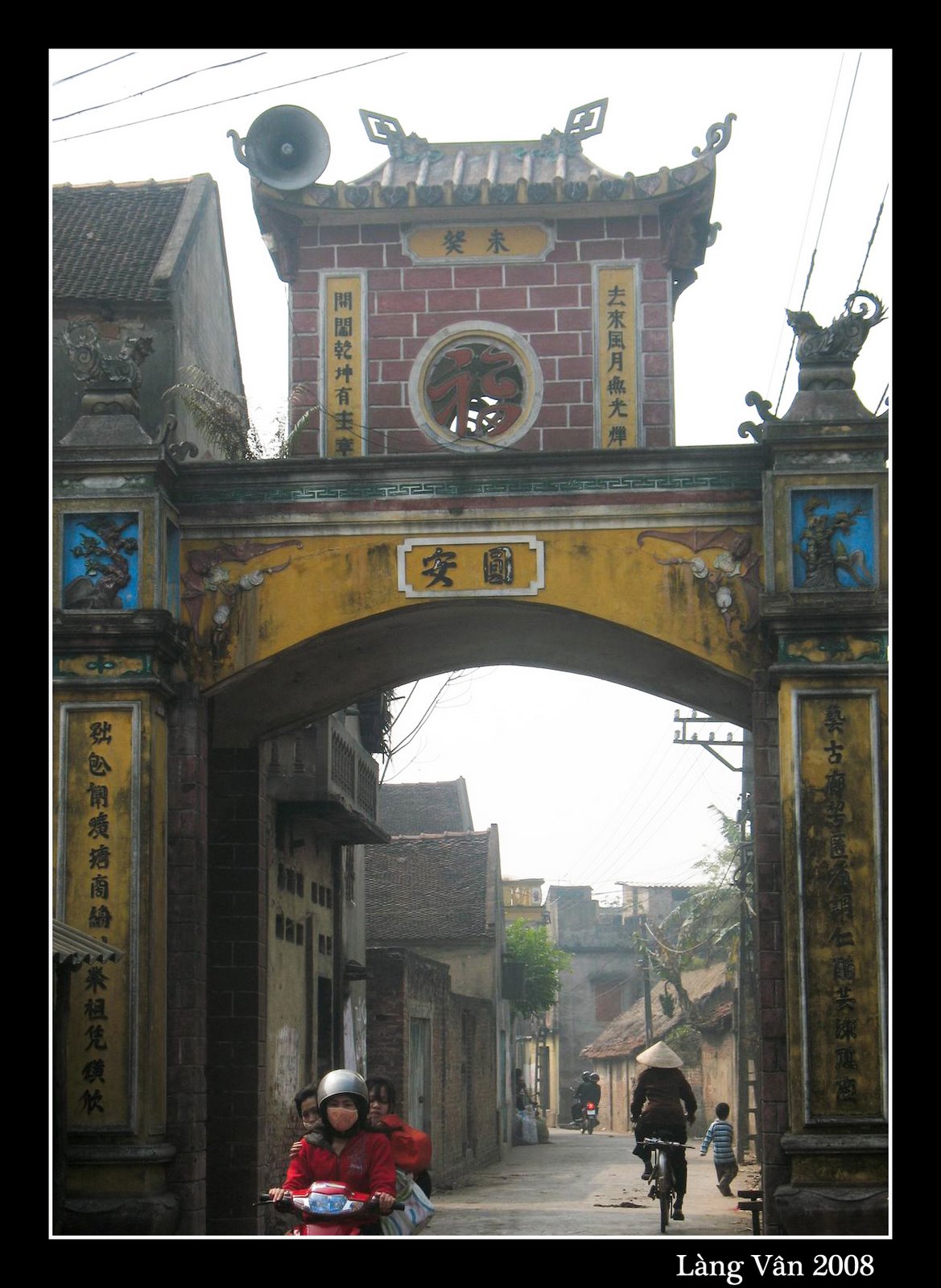
I've heard about its reputation for a long time, and now I've come to this famous winemaking village that has become a brand without needing to build wine, Van Village. I can see that it's truly a "name that cannot be passed down"…
The village stretches along the romantic Cau River, on the other side is Bac Ninh city (Bac Ninh Province). The economy is in recession, while many other craft villages are in a slump, workers are unemployed, businesses manufacturing and trading traditional products of the village have gone bankrupt… the people of Van Village can still make a living by making wine.
Every morning, wine flows from the village to Van wharf, to Bac Ninh, and from there it spreads everywhere. Asking about Mr. Ha, a young man who had just loaded twelve barrels of wine, each containing one hundred liters, onto the boat, he said that was the amount of wine that his furnace had cooked for two days, and that every two days he transported the wine to deliver to the agent in Bac Ninh:
– Van wine profits little, but maintains its quality, consumes a lot, and lives thanks to that.
Van Village's literal name is Yen Vien, now belongs to Van Ha commune (Viet Yen district, Bac Giang province). Villagers said that Van wine was initially cooked with rice. But since 1954, when the Government banned alcohol to save food, the people of Van Village were unemployed. Unemployed but not losing their job, around 1970, seeing that the source of sweet potatoes was quite abundant, the people of Van Village made wine with potatoes. From potatoes, they switched to making wine with fresh cassava, then dried cassava. And it was the people of Van Village who found the secret to eliminating toxins in cassava, making Van Village's cassava wine safe, no different from rice wine. An application accompanied by a project to produce wine from crops was signed by the people of Van Village and submitted to the province and the Government. Considering that this project has high economic efficiency, the Government has allowed it.
So the wine industry in Van Village revived, bringing the village's life to a higher level. Journalist Vu Tu Trang also kept some data, that is, around 1978 – 1980, the year dry cassava wine took over, Van Village had over 600 households, every family brewed wine and raised livestock, each day a household produced an average of 30 liters of wine, that is, the whole village had 18,000 liters per day, and each year, over 1,000 tons of pigs were sold by raising on wine residue. Today, Van Village has 860 households, and from the day of innovation until now, dried cassava root has completed its "historic mission" for the villagers, because Van wine has returned with the traditional ingredient of rice. And since then, although there have been no specific statistics on the village's annual wine output, hundreds of wineries in the village still never turn off the fire. And the village has truly become urbanized from the wine industry…
When did the wine making profession in Van Village originate? From the four verses of the song "Van Huong, we are a famous village/ In the pre-dynasty period, we offered wine to the king/ That is the profession that our ancestors gave us/ To do prosperous business forever…" heard in the village, we went to find the answer to that question. The first interesting thing we saw was that the person who taught the village how to make wine was not a man but a woman. That's Ms. Hieu Nghi Dinh. Wine, according to Chinese history, right from the time of Hung King, Van Lang people knew how to use the core of the bamboo tree to ferment and cook. Mrs. Hieu Nghi Dinh, although not originally from Van Village, discovered that the village's heavenly vein can be brewed into this wonderful wine, and she raised winemaking into a traditional profession, on par with any traditional profession in our country.
That's right! The same rice, the same yeast, if cooked in another place, could never produce a wine with a special flavor like this wine once praised by King Le as "Van Huong beautiful wine". She was revered by the villagers as the Patriarch of the Craft and then as the Village's Tutelary God, worshiped in the Van Village communal house. The communal house was built in the year of Nham Tuat (1682) during the reign of Le Trung Hung. So it can be seen that the wine industry in Van Village has existed for at least four centuries. After nearly three hundred years of existence, the incense smoke never stopped. In 1947, the communal house was burned by the French army. Elders Nguyen Khac Lai (88 years old), Diem Dang Dan (79 years old)… are still very sad when recalling this story:
– It is a beautiful communal house, in which there are many precious artifacts from the Le Dynasty. The communal house is located along the Cau River, facing the river, in front of the communal house is a vast green mulberry field, making the scenery even more charming. During the festival, the men and women of the Northern family often sit on the boat and sing, then stop by the boat to celebrate, and enjoy Van wine with guests from all over…
From the day the communal house was burned by the enemy until 2004, the communal house's land area of 1,541 m2 remained intact. And for decades now, the people of Van Village have had a very passionate wish to contribute their contributions to rebuilding the temple. In 2006, the People's Committee of Van Ha commune decided to establish a subcommittee to build and restore Van Village communal house headed by Mr. Nguyen Duc Quang. However, when starting to build, something happened. According to people's feedback, in 2004, the commune "borrowed" over 200 m2 of communal house land to build a kindergarten, and then took about 100 m2 more to make a "fairy garden" for the children. Up to now, the actual area is only 1,173 m2. That's why the competent authorities have not yet allowed the communal house to be rebuilt on the old foundation, even though people have submitted applications dozens of times. Mr. Nguyen Duc Quang said:
– Building a kindergarten is also to serve the villagers. Now, moving the kindergarten will cost hundreds of millions of dong. Therefore, the villagers did not ask for all of the communal house's foundation area, they only asked to be allowed to build on the remaining 1,173 m2 area. The old communal house had 7 rooms, now rebuilt opposite the kindergarten, it still has 7 rooms in length. The total suspension area is several hundred square meters. Nearly a thousand square meters remaining will be used as a communal yard, connected to the children's "fairy garden". And so the children will have an extremely spacious and airy playground.
Children will be exposed to a fairy tale from their own homeland, which is a fairy tale about a woman who has brought wealth and prosperity to her hometown for many generations. If so, then along this "flowing water" river there will be another tourist destination. Every spring, tourists following the Cau River to Quan ho villages in Bac Ninh will have the opportunity to visit Van communal house and enjoy the village's famous fine wine… It seems that the wishes of the people of Van Village are also legitimate and reasonable.